When senior Amelia Lawrence first volunteered to join assistant professor Micayla Lacey’s lab, she didn’t realize research was an integral part of study in the Wilkes Division of Behavioral and Social Sciences.
“I didn’t even think it was an opportunity that undergraduate students had, so I had no expectations,” Lawrence says. “I’m so glad I did it, because it changed my entire career path.”
Three years later, she’s assisted Lacey with research investigating factors influencing how boredom and motivation manifest in the brain. Now Lawrence plans to earn master’s and doctoral degrees in clinical psychology with a career goal centered on research and teaching. Two months before graduation, she is already accepted into graduate programs. Experience doing research gave her the edge.
“It’s all because of joining the research lab,” Lawrence says.
While many associate psychology with clinical practice such as counseling, it is a field grounded in research, with experiments yielding data on human behavior, mental processes, and the physiology of the brain.
At Wilkes, psychology faculty actively engage in research that contributes to their field while providing students with opportunities to enhance their education. Students develop more sophisticated skills and attend national and international conferences to present their findings. In addition, the faculty-student research partnerships inspire topics for capstone projects that all psychology majors must complete.
Researching the Adolescent Brain
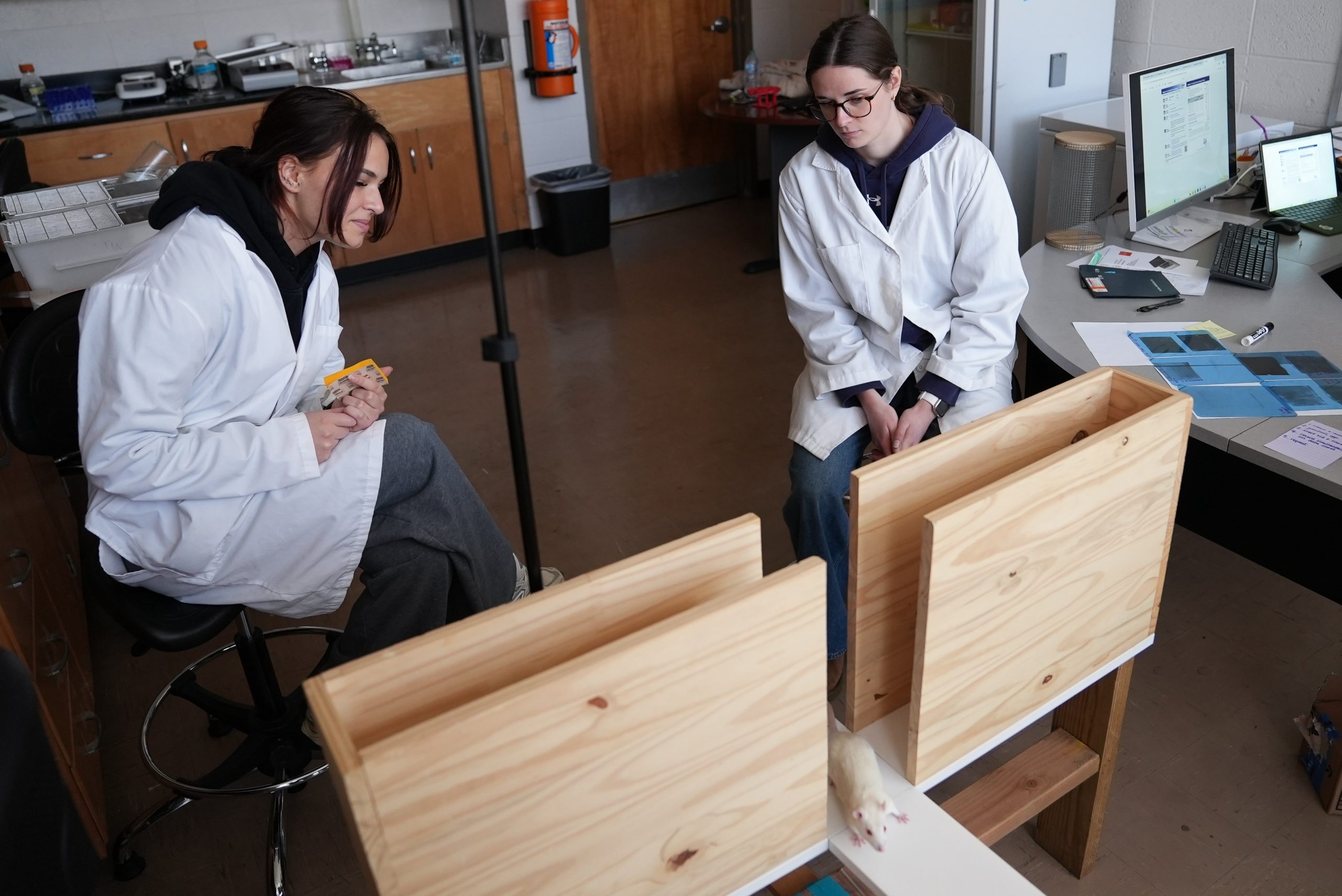
Jessica Anderson, associate professor of neuroscience, studies adolescent brain development, examining how various factors leave lasting impacts into adulthood. Anderson uses rats for her research. Her research paper recently accepted by the journal Brain Research focused on the long-term effects of high fructose corn syrup on behavior. Adolescent rats were fed the sweet syrup in their drinking water. “Were those (diet) choices you made in your adolescence enough to screw up your brain trajectory?” Anderson wondered. She found that the adult rats who consumed excess added sugars during adolescence, were less motivated, showed higher rates of depression and more anxiety, as well as associated changes in brain proteins.
Using a similar model, Anderson has spent the last three years studying the effects of acetaminophen – a common painkiller – on adolescent rats. In her initial findings, she found differences in anxiety and impulsivity-related behaviors. “(It) is affecting brain development and it’s sex specific,” she notes.
Brady Bielecki and Bella Lesante are among several Wilkes undergraduates assisting with her research. In November, they will accompany Anderson to present their findings at the international Society of Neuroscience conference in Washington, D.C.
Bielecki says he’s learned that science requires painstakingly tedious work, such as watching rats’ behavior for hours on video. But he wouldn’t have it any other way. “You get an addiction to doing science…you don’t know if it’s going to turn out right, but once you get those results, you get that dopamine boost.” Lesante, a senior neuroscience major, transferred to Wilkes because of research opportunities. She plans to attend optometry school and says that, in addition to learning sophisticated skills such as analyzing solutions in the lab, her biggest takeaway is personal. “It’s made me more confident and motivated to put in the work and do things that are going to contribute to the betterment of public health.”
Studying Anger and Attitudes
Ellen Newell, associate professor and psychology department coordinator, has been researching anger and its potential to motivate positive change. “There was some research that said you either have to have hope or you have to have anger (to inspire change), and we showed that you really need a combination of the two,” Newell says. “You need to have some hope, because if you have no hope, you’re not going to feel you can do the things needed to make the change you want, but anger puts the fire under you.”
To further test this, participants in her study completed surveys that assessed their willingness to reduce inequities and fight for social change. “In our work we have found some evidence that when people are hopeful that positive change is possible and at the same time also feel anger about those inequities, that is most predictive of when people will take action needed to make change,” Newell says.
That research inspired senior Jazmin High’s capstone project. After working as Newell’s research assistant for three years, High developed capstone research examining people’s perception of anger in women. Participants in the study were presented with scenarios in which different women are expressing opinions about issues affecting women, such as equal pay. In some scenarios, the women will express their perspective with anger, others more matter-of-factly. In the scenarios, opinions will be expressed by famous women such as Taylor Swift and Beyonce as well as an unknown woman.
“We use the non-famous person to see if she would still be regarded as having more competency than Beyonce or more warmth than Beyonce,” says High, noting she’s curious if she will see differences of peoples’ perception of anger in Black and white women. She will also consider whether Beyonce’s and Swift’s fame soften people’s impressions when they express anger.
Senior criminology and psychology major Skylar Forella also has worked in Newell’s lab for three years, leading to her capstone analyzing how individuals’ personal experience of life success, such as entering college, impact their attitudes about people struggling with things such as food insecurity or unemployment. Forella says, “Working with Dr. Newell has greatly expanded my worldview and how I think about and process ideas.”
Motivation, Boredom, and Conflict
How is brain activity affected by the tension of continuing a task when you’d rather be doing something else? That is a key question in Micayla Lacey’s research assessing how neural activity is impacted by motivational conflicts. She cites an example that’s relatable to her students. “Maybe I’m not finding studying to be enjoyable…, maybe I’m even a little bit bored with it, but I know that is congruent with my long-term goals of getting an ‘A’ in the class,” she says.
Using electroencephalography, or EEG, which involves attaching a cap with electrodes to the scalp, Lacey and her team measure tiny electrical impulses given off by the brain. It allows them to see differences in brain activity. She and her students are using it to compile data in a study examining how motivational conflicts, such as boredom, influence brain activity.
In the study, research subjects view the same set of images repeatedly for long periods. “Does brain activity differ when people are able to keep doing that boring thing versus when they stop?” Lacey says, noting that she also is identifying which hemisphere of the brain is involved during such activity.
Students Amelia Lawrence, Kendra Hard and Jean Bonn work in her lab and benefit from developing skills they can use doing research in graduate school, such as operating the EEG. “I did not think I would be allowed to do that coming into college,” Lawrence says. More recently, she’s learned computer programming to complete her capstone.
The students accompanied Lacey to the Society for Personality and Social Psychology held in Chicago over spring break. They presented their research poster on motivational conflicts and attentional scope. “Dr. Lacey and other professors are always looking for opportunities to help us,” Lawrence says.