Are you ready to transform the way you teach and connect with students? Reimagine classroom management, further empower your students and make a deeper impact through the “Wired for Connection” event at Wilkes University from 4:30 – 8 p.m. on Tuesday, July 14, in the Dorothy Dickson Darte Center for the Performing Arts, 239 S. River Street, Wilkes-Barre. The event is free and open to the public, but registration is required.
Lori Desautels, PhD, assistant professor at Butler University, will deliver the keynote address. Desautels studied neuroscience and was a former special education teacher and school counselor. She is the founder of the Educational Neuroscience Symposium at Marian University in Indianapolis. Her work focuses on engaging students through social and relational neuroscience, including the Applied Educational Neuroscience (AEN) framework.
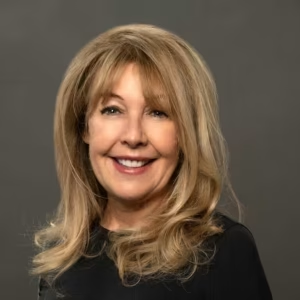
Desautels participated in a brief question-and-answer interview to shed more light on how this professional development opportunity will help others to better understand how brain science and the nervous system affect our relationships, communication and behavior.
Wilkes: Why is the “Wired for Connection” event so important and beneficial for educators?
Desautels: It’s important because our nervous system is a social organ; we are wired for connection neurologically and biologically, meaning we cannot survive without each other. Many children and youth we serve across the country and in the world come into our schools with relational poverty; coming to school where emotional safety and connection are a priority. It’s a paradigm shift that begins with adults.
Secondly, we are seeing educators challenged with burnout. They’re overwhelmed with academic performance from state level to federal that it feels next to impossible for a lot of our teachers and paraprofessionals to actually cultivate deep relationships with our students.
Thirdly, it is critical in learning. Academic performance increases when children feel a presence of felt connection and safety. It’s a systemic, global and national issue, and I feel for our administrators in schools because they want to be supportive, but it is challenging to find the resources to nurture staff.
Wilkes: How does awareness and co-regulation relate to brain science and the nervous system?
Desautels: We are learning robust research that is helping us to understand that the brain and body are in constant communication. Our nervous system has its own language: sensations. Sensations are the physiological signatures of the nervous system. They are intimately tied to emotion, but oftentimes our children become conditioned out of their bodies as they grow – heads go one way, bodies go another way – and we lose the language of sensation. This is a pillar in the AEN framework. When we can all become fluent in that language, we can reach the root of the behavior. When we think about emotions, we traditionally react. I want us to begin thinking of emotions as instructions and direction. What is my nervous system asking for? We can control how we choose to respond. The nervous system is always speaking to us.
Wilkes: When working with students and educators, what are they generally surprised to learn about themselves and others through brain science?
Desautels: They’re surprised and somewhat resistant to understanding there is physiology and biology beneath behaviors. Oftentimes they look at the behavior as manipulation – disrespectful, intentional, oppositional and defiant. It may look that way on the outside, but they’re surprised how that child embodies lived experiences, their generational trauma, their perception, their living and survival state most of the time. That’s been a big “aha” moment. Trauma has become watery and loose; trauma is on a spectrum – ubiquitous, but it’s more about what happens inside of us than to us.
Wilkes: If you had a magic wand and could change anything about how teaching is approached, what would you change?
Desautels: I would love for schools, communities and families to understand that deep breathing changes our biology and we are sensational beings. We are sentient creatures who feel. Breathing, movement, journaling, writing are ways we can access the cortex through our procedures as parents, caregivers, leaders, teachers and more.
Wilkes: What is the biggest takeaway you’d want people to remember from attending the “Wired for Connection” event?
Desautels: All behavior is biology, and we have this amazing superpower of neuroplasticity. We have the ability to change, structurally and functionally, based on our bodies’ experiences.
Attendees will learn practical strategies to strengthen connection, regulate emotions, lead with compassion, practice empathy and more. Join Desautels and other experts to explore the program’s themes below:
- The impact of adversity on learning and behavior
- Designing curriculum for connection and cognitive growth
- Creating safe and engaged learning environments
- Identifying and minimizing barriers to learning and behaviors
The event will also include poster and resource presentations, as well as displays from community resources.
Act 48/Continuing Education (CE) credits will be available for this event. Registration is still open and can be completed online at wilkes.edu/wired.