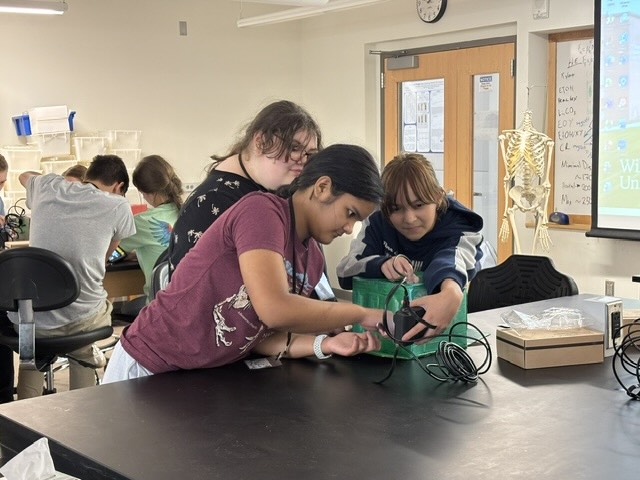
It may be summer break, but more than 100 someday scientists spent a week living the lab life at the We’re Empowered by Science camp on Wilkes University’s campus.
The camp, better known by its acronym WEBS, gives students in grades 7-12 a chance to wade into the world of STEM through fun, hands-on projects in science, technology, engineering and math. WEBS opens the door to all, providing a glimpse at college life and career possibilities while fostering leadership, team building and collaboration.
“They get to see what they may be interested in for the future,” says Miquela Langan, WEBS program director. “The goal is to expose them to all areas of science within a week’s time.”
That’s a tall order, but Wilkes faculty, staff and undergraduate students presented a full slate of labs and activities.
In a session titled, “You Be the Doctor,” the seventh and eighth grade students used medical details to act out a skit complete with symptoms and a diagnosis. They also learned about nutrition and genetics, dissected a frog, cleaned up an oil spill, built a robot and studied disease outbreak in a zombie apocalypse.
The students in grades 9-12 are in WEBS 2.0, a part of the program which grew out of requests of previous campers who finished middle school but weren’t ready to be done with WEBS. In addition to introductions to animal behavior, insect collection and urinalysis, the high schoolers took a field trip to the nearby Montour Preserve to hunt for fossils.
While on campus, the WEBS 2.0 groups had a chance to dive deeper into the scientific process in research lab sessions. Earlier in the week, students were surveyed and divided into teams by their interests. They came up with hypotheses, conducted experiments to prove or disprove their initial idea, then shared their findings in a poster presentation to cap off the week.
Rowan K. of Scranton Preparatory School, Nzia Nkamjeu of Crestwood Secondary Campus and Destiny Blade-Sitler of Wyoming Valley West tested containers made of three different materials to find out which one would keep water colder longer. They knew plastic wouldn’t do the job, but they guessed popular stainless steel travel mugs would keep their cool. After taking and recording the temperatures of the water in each bottle, the group found aluminum to be the most chill.
“The results really surprised us,” says Rowan K.
Another group, Heeyeon Kuen of Crestwood and Dahlia Ayres of Wyoming Area, tested the tooth whitening power of popular dental hygiene products. They used eggshells to simulate teeth, stained them for 10 hours and then treated them with Act mouthwash, hydrogen peroxide and Listerine. Act gave their fake smiles the whitest gleam.
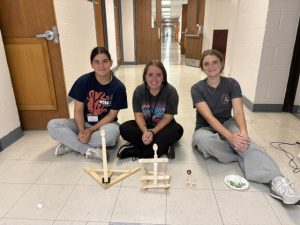
The research lab brought out some friendly competition too. Savannah Rafuse Franco of Wyoming Valley West joined Rylee Parry and Daria Clarke of Wilkes-Barre Area STEM Academy to construct catapults of different sizes and materials. The trio launched a variety of items including cotton balls, Hershey Kisses and a plastic spider, learning that the sturdiest device and heaviest object launched the farthest. They bragged that their catapult could go the distance against another team’s trebuchet. “Ours is a lot better. We already know the data.”
The trio, all returning WEBS campers, also know that they’ll be pursuing education and careers in STEM, with exercise science, forensic science and marine biology among the possibilities.
WEBS does seem to have a hold on its campers. Take Hannah Dittus ’26. She has been involved with WEBS for 12 years, starting as a camper. Her group encouraged the WEBS 2.0 program, and she was part of the first session for high school students. As a biology and secondary education student at Wilkes, she served as a WEBS group leader, and even graduation hasn’t kept her from returning to WEBS.
“At the first camp, the professors here showed me that I wanted to study biology. I looked up to my group leaders so much, I wanted to be able to be one of those people,” says Dittus. “This is my favorite week of the whole, entire year.”