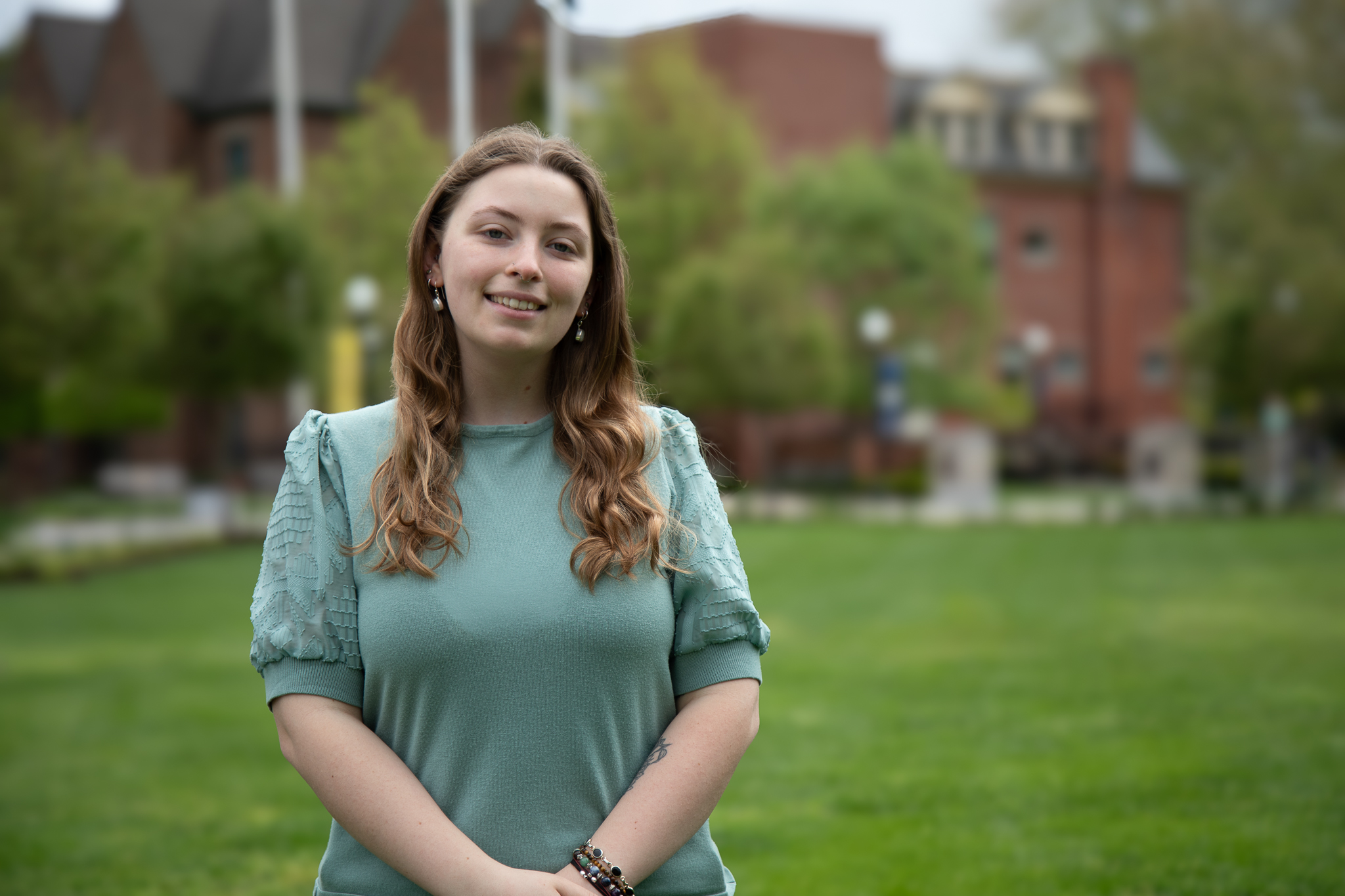
Don’t ask Amelia Lawrence ’26 about the projects she worked on with Micayla Lacey, assistant professor of psychology. She won’t share any details because she doesn’t want to risk skewing the results of the studies. What Lawrence gladly revealed is that the opportunity to do research as an undergraduate student changed the course of her life.
Though the senior has long had an interest in psychology and helping others — a note in her sixth-grade time capsule said she wanted to be a therapist — Lawrence planned to focus on a career in counseling. Then, Lacey invited her to join the lab team.
“I’ve been doing research with Dr. Lacey since my sophomore year. It’s the most impactful thing about Wilkes,” says Lawrence.
As part of Lacey’s team, Lawrence collected, cleaned and organized participant data. She was also trained in electroencephalogram (EEG) techniques to measure brain waves. “Amelia has been fantastic in the lab,” says Lacey. “She’s developed a lot of skills.”
As both her research and academic advisor, Lacey had witnessed that development over the last three years. During that time, she also had Lawrence in class, worked with her as a tutor for PSY 101 General Psychology and supervised her internship in the NeuroTraining and Research Center on campus.
The NeuroTraining and Research Center, serving the University’s students, faculty and staff at no cost, uses cutting-edge equipment and techniques to help participants improve focus, reduce stress and heighten athletic performance. Interns gain high-level experience, managing the desk and serving as neurofeedback and biofeedback technicians, with Lacey as the center’s director.
The real-world skills Lawrence gained as an undergraduate researcher and an intern are not typical of the college experience at many schools, but they’re a result of the strong mentoring culture at Wilkes.
“When students are looking for a university, they don’t realize the opportunities available at Wilkes,” says Lacey. “In our department, we’ve always been big champions of undergraduates. The value of Wilkes is that you have these opportunities.”
The psychology major also found plenty of opportunities outside of the lab. She minored in sociology and women’s and gender studies. “I really like being busy,” says Lawrence. “And all of this is fun.”
Even when she had a break between classes, the commuter student from West Wyoming, Pennsylvania, always found something to do. “There is never a single second where there’s not something going on, to the point where you have to pick between events, and for the most part, they’re all free,” says Lawrence. “So, you just have a bunch of opportunities to meet people and do things while you’re here.”
Lawrence also had the opportunity to serve as president of the Psychology Club. The club’s faculty advisor, Deb Tindell, professor of psychology, saw the senior’s leadership skills grow since she started at Wilkes, both in the club and as a tutor. Lawrence sees Tindell as another mentor, stopping into her office for a quick update that turned into a longer chat about the club, class, grad school or career plans.
“They’re all great professors in the department,” says Lawrence. “They’re all very invested in the students.”
Tindell finds that investment in students to be the most rewarding part of her job, particularly when it comes to supporting students like Lawrence who discover that there may be multiple paths to a successful future.
“If you know what you want, you may not get there the way you initially intended, but you can still get there,” says Tindell. “Sometimes it’s a matter of reassessing what your goals are. It’s okay to change direction.”
With a clear direction in mind, Lawrence applied to master’s and doctoral programs, followed by a career as a clinical researcher and college professor — all thanks to lab doors opened at Wilkes.
“If you take advantage of all the opportunities in the psychology department, it sets you up very well,” says Lawrence.