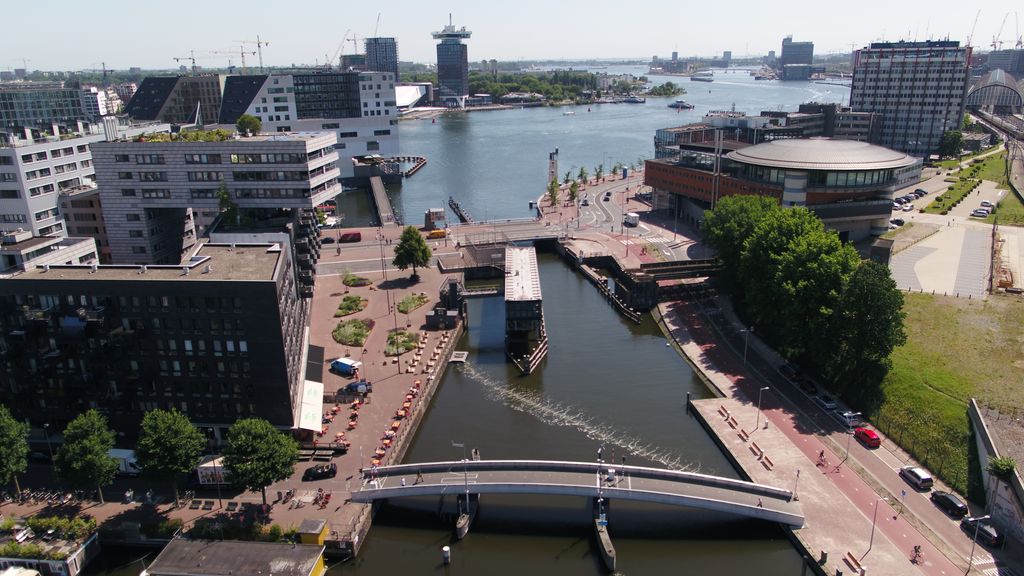
The key to cleaning up plastics in the Susquehanna and other American rivers could come in the form of something as ephemeral as a bubble.
Members of the Wilkes community learned about that when the Cohen Center for Entrepreneurship and Innovation hosted a three-day visit from April 13-15 with representatives of The Great Bubble Barrier. The Amsterdam-based company has developed an innovative way to remove plastic pollution from rivers before it reaches oceans using a bubble curtain.
The company, founded in 2017, already has placed its system in four cities in the Netherlands and one in Portugal. The Wilkes University event was the first stop on the company’s first visit to the United States. Company representatives also were meeting with officials in Lansing, Michigan, Milwaukee, Wisconsin, and Chicago.
Philip Ehrhorn, co-founder and chief technology officer of the Great Bubble Barrier, gave three lectures – one for engineering students, one for business students and an evening public lecture – explaining the company’s innovative technology.
“We place a perforated rubber tube on the bottom of the river, and then we pump air into it, which creates a curtain of bubbles rising to the surface that can lift up plastics underwater to the surface,” Ehrhorn explained. “Then at the surface, the plastics are guided along that curtain of bubbles towards the collection area.”
The technology does not impede ship traffic or significantly disturb wildlife. Ehrhorn noted that the amount of plastic pollution continues to grow. “It’s currently projected that by 2050 we’ll have more plastic in our oceans than fish by weight. And that’s not something I think a lot of us want to see when it comes to single-use plastics,” Ehrhorn said, adding that recycling hasn’t provided a solution.
Students in the College of Business and Engineering also interacted with Ehrhorn and Zoe Dupey, Great Bubble Barrier account manager, informally over lunches, dinners and other networking opportunities.
“The purpose of scheduling several talks over multiple days, along with picnics, lunches, and dinners, was to give students the opportunity to build deeper connections with Philip and Zoe. Many Kirby Scholars and members of the Dean’s Student Advisory Board were involved in introducing and escorting the visitors around campus, which further strengthened these interactions,” said Terry Chase, executive director for the Cohen Center.
HyeRyeon Lee, associate professor of hospitality leadership and department chair, Marketing and Sports Management, said the lectures were valuable for students who attended. “It helped them see how a simple idea can become a practical solution with real environmental impact. The presentation made it easier for them to connect what they learn in the classroom to real-world applications, particularly in how sustainability and innovation come together in practice.”
Marleen Troy, a professor of civil and environmental engineering who also serves on the Riverfront Parks Committee, agreed about the benefit to students. “Just to be exposed to that different way of thinking that’s outside of the box is always a good thing,” Troy said, noting that it’s good for students to see that being an entrepreneur can be a career option.
Interacting with an entrepreneur was inspirational for students like Bara’a Kamal and Alexandra Peccerilli. The women – both sophomore mechanical engineering majors – recently competed in the 24th Annual tecBRIDGE Business Plan Competition. They presented the plan for their start-up, A & B Robotics, developing passive prosthetics for individuals with limited hand or wrist mobility.
“As a current engineering student and young entrepreneur who recently presented a pitch in a business plan competition, it made success like his feel much more attainable,” Kamal says. “I could see parts of my own journey in his story, which made the experience even more motivating and reinforced my interest in pursuing innovative solutions through engineering.”
Ehrhorn’s visit was part of a semester-long river innovation study. The river focus was chosen because of the University’s proximity to the Susquehanna. It created an opportunity for what Chase calls an ecosystem project, bringing together entities from on and off campus who have a stake in the river’s future. It was one of more than a dozen projects in spring 2026 chosen by students who are Kirby or Cohen scholars. Students are paired with faculty mentors to work on real-world projects. A committee of faculty and students from the College of Business and Engineering advised the river project.
Kirby Scholars Steven Millan, a senior business management major, and Gurinder Badwal Singh, a graduate engineering management student, chose to work on the river project.
Millan, in his role as a Kirby Scholar and a Cohen Scholar, helped Chase to identify companies with river-related projects. He also developed a list of community organizations – from the Riverfront Parks Commission to the Chamber of Commerce – with a stake in river issues who would be invited to the event. Leveraging his role on the Dean’s Student Advisory Board in the College of Business and Engineering, he recruited student volunteers to staff the three-day event. Ehrhorn’s entrepreneurial journey resonated with Millan.
“The most interesting thing that I learned was his sheer dedication and interest in his business. One question I asked him in passing was ‘What is your favorite part of the process?’ He then listed just about every aspect of the actual physical labor involved with the implementation of the tube. In my opinion, the more involved you are in your work, the more successful you will be,” Millan said.
Singh, who worked as a civil engineer in the United Arab Emirates prior to enrolling in the master’s degree program at Wilkes, chose the project because it matched his engineering skills. Using the specifications from the Great Bubble Barrier’s current projects, he researched rivers in the United States that might be candidates for using the company’s technology. He will share his report with them.
“We are working on finding a particular stable location for the Great Bubble Barrier so it can be installed and remove plastics,” Singh said, noting that the depth and velocity of rivers are among the factors that determine whether the bubble barrier can be used. The visit reflected the Cohen Center’s goal of inspiring entrepreneurial thinking and innovation while supporting all students through mentorship, events and engagement.