During her time at Wilkes, Emily Romanoskey of Edwardsville, Pennsylvania, has curated a gallery of experiences designed to help her create a career surrounded by art.
Romanoskey, a digital design and media art major, transferred to Wilkes after completing two years at Luzerne County Community College. She was familiar with the University located minutes away from her hometown, but wasn’t aware of all the experiences that would give her a preview of the professional world.
As a senior, Romanoskey is in the process of fine-tuning the portfolio that she’ll share during capstone presentations. Much of her creative work for class focuses on illustrations inspired by her love for cats and Hello Kitty. She’s developed a line of toy packaging as well as branding for a sushi restaurant. Other students’ skills might lean toward book design, sports logos or movie posters, and faculty encouragement of that variety is one of Romanoskey’s favorite things about the DDMA program.
“I like how they’re supportive of you doing what you want to do,” says Romanoskey. “None of our portfolios are the same. We all kind of do our own things.”
In addition to the portfolio and the capstone presentation, DDMA requires every student to gain real-world experience through an internship. Romanoskey took IM 101 Integrative Media Foundations with Heather Sincavage, associate professor and director of the Sordoni Art Gallery. During class, Sincavage mentioned student design opportunities available at the gallery and Romanoskey was intrigued. “That was my first introduction,” says Romanoskey. “It seemed really interesting to me and it was something I wanted to get into.”
Romanoskey started in a work-study position, collaborating with a team of 10 students to create art hero cards, posters and social media graphics to promote exhibits at the gallery. Romanoskey asked about a potential internship and mentioned an interest in a gallery career. Sincavage and Melissa Carestia, assistant director of the Sordoni, were thrilled to provide an avenue to explore the work behind getting art on the walls and welcoming guests to an exhibition.
As an intern, Romanoskey experienced the life of an exhibit from start to finish. She was involved with the development and implementation of a show’s thesis, as well as the programming of events to attract different audiences. She communicated with artists and vendors. Romanoskey also assisted with condition reports, as well as the installation and take down of art pieces.
“This is the work of a gallery,” says Carestia. “This is the work people don’t normally see because when they come here, they see everything up on the wall, everything all together. Most of the time, they don’t really know all that goes into a show.”
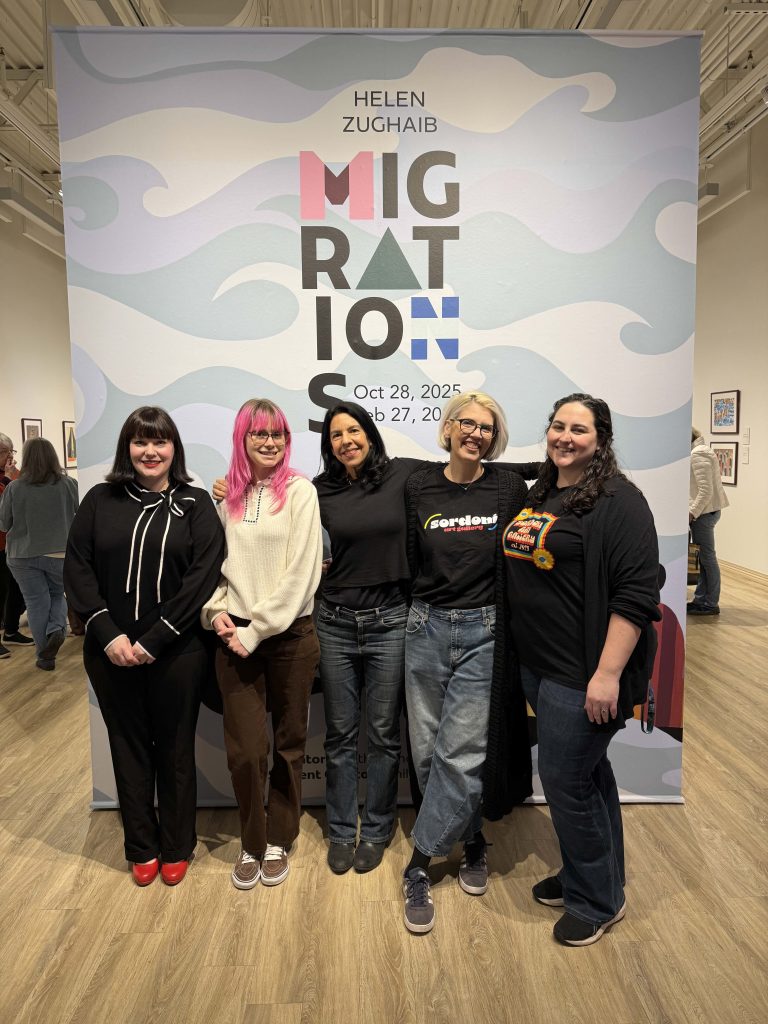
Helen Zughaib’s Migrations show, which ran during the fall semester, really gave Romanoskey an opportunity to display a combination of skills she practices in the classroom and the Sordoni. As student curator for the show, Romanoskey researched Jacob Lawrence’s 1941 Migration Series, which served as inspiration for Zughaib’s work.
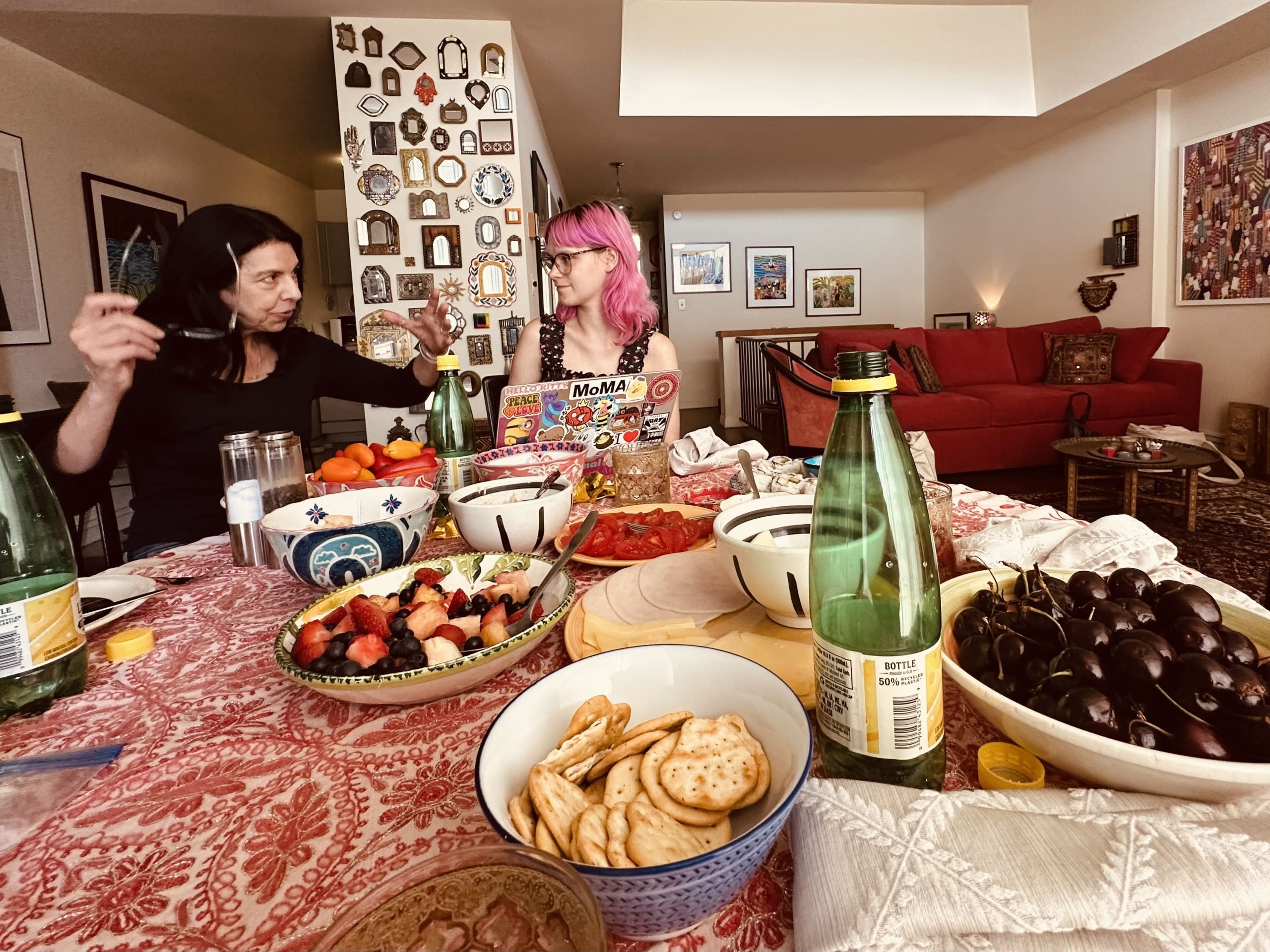
Courtesy of funding from a mentoring grant at Wilkes, Romanoskey traveled to Washington, D.C. with Sincavage and Carestia to visit Zughaib at her studio. While in D.C., the trio toured the Phillips Collection and the Portrait Gallery. They also went to the Museum of Modern Art in New York. The summer museum tour gave Romanoskey the opportunity to explore Zughaib’s inspiration and creative process, as well as design and layout choices of other gallery exhibits.
“It’s rare that I get to take a student out with me to meet with an artist,” says Sincavage. “And, she’s the first student we ever gave the billing of student curator because she had such a significant part in the research and planning aspect.”
Back on campus, Romanoskey created the branding for the Migrations show at the Sordoni — the first venue to host the entire series. Using the brand she developed and had approved by Zughaib, Romanoskey worked with other students on posters and banners to draw guests through the gallery doors.
According to Carestia, Romanoskey has a talent for explaining her work and communicating with other students so all of the materials have a cohesive look. “She understands designing as a team,” says Carestia. “She’s very good at that.”
For Sincavage, giving students like Romanoskey the room to grow is another part of the gallery’s mission. “It was great to see that she has these leadership capabilities,” says Sincavage. “Mentoring is the culture that we have here and peer mentoring is so important.”
While creating the visuals for Migrations may have been a team effort, as student curator, Romanoskey was responsible for creating the exhibit catalog. She did research to draft an essay comparing Zughaib’s and Lawrence’s work, designed the 100+ page book and worked with the print vendor on production.
“The catalog was really challenging,” says Romanoskey. “I never made anything that big or that professional before. Everything I had made before had been for class, so that was a big jump.”
As challenging as the project was, Romanoskey admits it was also fun. And, when she felt stuck on any gallery work, she could always count on Carestia, Sincavage and the student team to brainstorm ideas or offer helpful advice.
“They were so supportive, but real with me at the same time,” says Romanoskey. “You need somebody who can give you critiques of your work without making you miserable. They really want you to do the best that you can and they’ll help you in any way.”
This support and encouragement have allowed Romanoskey to create high-quality work that’s collecting accolades outside of Wilkes. Earlier this spring, she was recognized by the American Advertising Federation of Northeastern Pennsylvania (AAF NEPA). At the organization’s awards banquet, Romanoskey received the Student Judge’s Choice Award, the Student Gold Award and the People’s Choice Award for her Migrations catalog design, as well as honorable mention for a packaging design she created for class.
While she’s grateful for the awards, with graduation approaching, Romanoskey is even more excited to show prospective employers her portfolio, which highlights a collection of cute creatures, effective gallery advertising and a commitment to creative teamwork.
“It shows I already know how to work in a professional setting,” says Romanoskey.