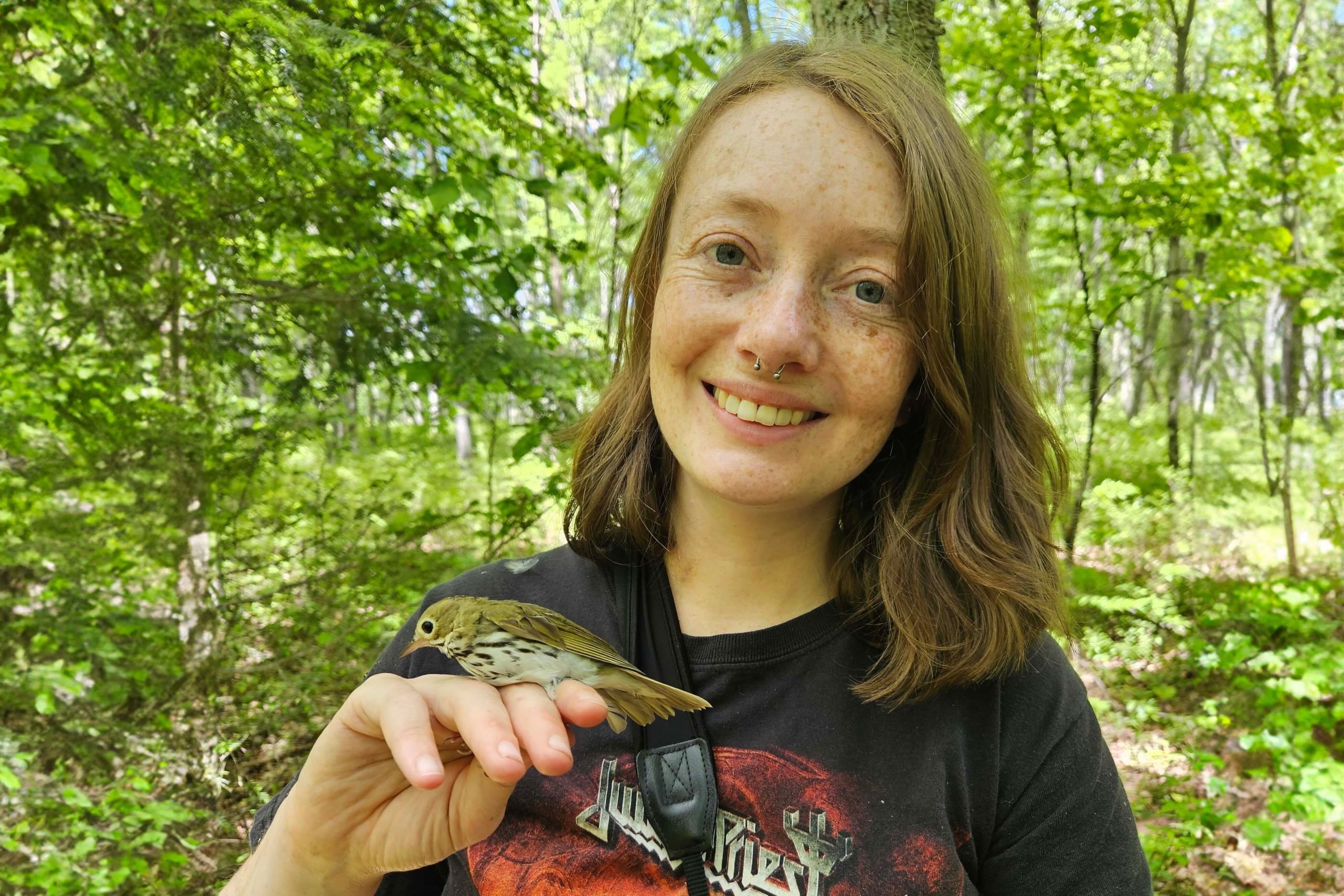
Amy Yanagitsuru’s curiosity about why animals do what they do led her to a career in biology. A lingering question from her doctoral research led to a prestigious fellowship and an opportunity for Wilkes students to take part in the Maine event — studying Atlantic puffins at a seabird colony in New England.
Yanagitsuru joined Wilkes as an adjunct professor of biology in 2024, winning the 2025 Teacher Recognition and Effectiveness Committee Adjunct Faculty Award for her work. Recently named a visiting professor of biology, she’s adding classes in mammalian physiology and animal behavior to her teaching schedule, sharing her lifelong curiosity with upper-level biology students.
“I’ve always been very interested in animals ever since I was a really little kid. I’m really interested in why animals do the things that they do. They live in a different world from us. We all live on the same planet, but their sensory world and their motivations and the kinds of priorities they have and what goes on in their minds is different from us,” says Yanagitsuru. “And that’s what I’m really interested in. What sorts of things go on inside their bodies and in their minds and in their evolution that affects what you see them do? That curiosity about why animals do what they do is what led me into this field.”
When Yanagitsuru graduated from Bryn Mawr College, she briefly considered a career in the arts before following her passion for biology to a doctoral program and the study of seabirds at the University of California, Davis.
“I decided that the best way for me to maintain both of my interests was to do biology professionally and indulge my artistic pursuits as a hobby,” says Yanagitsuru.
While she enjoys embroidery, beading and other crafts in her free time, in her work life, Yanagitsuru studies seabirds like the storm petrel, a creature who spends most of its life amid the gale force winds and crashing waves of the high seas.
“They spend almost their entire lives out there. Just this delicate, little bird in an environment that we need incredible technology just to survive,” says Yanagitsuru. “I think that’s one of the really cool things about seabirds is that the way they live their lives is so alien to us.”
For the next few years, her research will focus on making the unknown a little more familiar as a research team focuses on relationships, breeding and parenting in the puffin community.
Yanagitsuru was awarded a 2026 Kessel Fellowship for Ornithological Research from the American Ornithological Society for her upcoming project, “Puffin Love: Mechanisms behind the benefits of long-term pair bonding in Atlantic Puffins.”
In her PhD research, Yanagitsuru examined Cassin’s auklets, a seabird that resembles a small penguin. The species is perennially monogamous, which means they mate with the same partner year after year, though splits do happen. She noted that the auklet mothers who knew and trusted their partners seemed to form bigger, healthier eggs if they could count on their partners to care for the chick. Still, she wondered if the pattern of parental responsibility applied to other seabirds and their families, and if so, why?
With funding from the fellowship, Yanagitsuru — along with a Wilkes student and a collaborator — will travel to an animal refuge on an island in Maine to study Atlantic puffins over the next three summers. The small team will set up and maintain RFID readers to record when parents visit the nests and monitor the growth of chicks. The student will also take hormone samples from the puffin mothers to examine the investment in the egg and the growth of the chick. Using the data, the team will try to draw conclusions about the mother’s relationship with her mate and the size and strength of the egg that will hatch a puffling.
Though the research team needs to be small due to the ecologically sensitive area, Yanagitsuru plans to have additional students participate in the research. “I wish I could take a group, but at these refuges, there’s a limit to how many people you can have on a seabird island,” says Yanagitsuru. “But that doesn’t mean that we can’t have more Wilkes students involved in this project. After the field season, we’re going to have an incredible wealth of data.”
Yanagitsuru wants input from her class on what data to collect so students can investigate their areas of interest. The team can modify the system on the island to gather photos, puffin weights or other details about the birds. “This project isn’t just something that I’m dictating from the top,” she says. “It’s a collaborative effort by all of us.”
For Yanagitsuru, Wilkes provides an ideal environment for student research. The University has an ecology preserve nearby where her lab does most of its field work. Wilkes also offers support through its mentoring grants and connections to outside funding that allows for paid positions. “I can actually pay my summer research students, and that’s really important because not everybody can afford to do these things on a volunteer basis.”
While the next three years will be focused on classes, lab work and the puffin project, Yanagitsuru makes a concerted effort to keep some time outside of work for herself and set a standard for her students. “There’s absolutely an overwork culture, especially in field biology. It’s pretty toxic, and I want to lead by example,” says Yanagitsuru. “I try to really impress on my students that we shouldn’t be grinding ourselves into the dirt because creativity and really rich scientific thinking happen best when you’re rested.”
In her free time, Yanagitsuru enjoys beadwork, embroidery, knitting, crochet, gardening and hiking. She also has a particular interest in pre-1950 natural history books with first-hand accounts of extinct species. And, of course, birds are never far from her mind.
She talks about the storm petrel, a type of bird most people will never see because it lives its entire life on the high seas. There’s the albatross, whose metabolic rate is higher sitting on land than flying over the ocean since it’s suited to the water environment. Then there’s the puffin. “A puffin is an incredible, strong, really badass hunter. It’s like the most perfect underwater jet,” says Yanagitsuru. “Yes, they’re cute and they’re goofy, but out at sea, this animal is strong. Resilient in ways we can’t even imagine.”
After Yanagitsuru’s team gathers and examines three years’ worth of data, there will be less need to imagine. They’ll know more about Puffin Love, and why these animals do what they do.