Wilkes Professor & Students Publish Research on How E. coli Precipitates Calcium Carbonate and Its Positive Implications on Environment
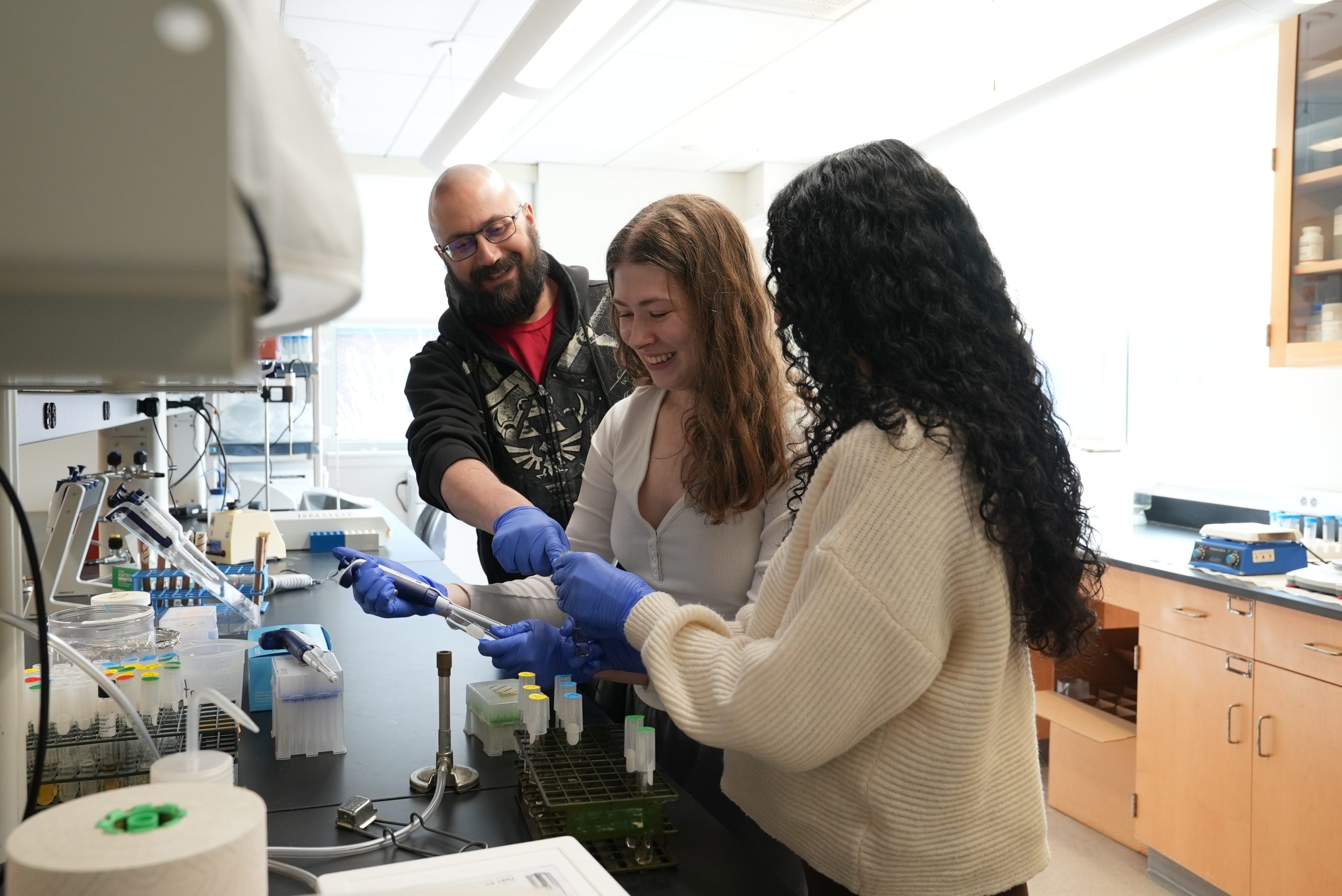
E. coli gets a bad rap. Associated more often in the public consciousness with illness and food recalls than with anything beneficial, E. coli (Escherichia coli) is actually much more complicated than its reputation suggests. In reality, most strains of this bacterium are not only a harmless part of our natural gut microbiome, but can actually be beneficial to humans. Wilkes assistant biology professor Matthew “Skippy” Jennings, PhD, is using his research to take our understanding of E. coli one step further. Specifically, Jennings, along with students Lorelei Centrella, Sara Bonn, Bisma Chaudhry and recent alumnus Aryln Rivera, researched how E. coli precipitates calcium carbonate, an important compound used in manufacturing for food, cosmetics, coatings and steel production. Their findings, which have great environmental and industrial implications, were recently published in PLOS ONE, a peer-reviewed journal published by the Public Library of Science.
Jennings’ work with E. coli originates during his post-doctoral research at the University of Akron. Initially, he set out to make a self-healing paint by adding microbes isolated from cave environments which would produce calcium carbonate to fill in any scratches. Because working with those rare microbes is difficult, Jennings substituted E. coli, a bacterial species which already has many tools for genetic and metabolic studies, in the hopes that his findings would be transferable. Interrupted by the COVID-19 pandemic, Jennings carried this work forward through his career. By the time he arrived at Wilkes in 2022, he was ready to resume his work with a new focus on how E. coli precipitates calcium carbonate, and how industrial manufacturing could harness this process.
The research Jennings’ and his team of students have done here has great potential for positive impact by reducing carbon emissions that are the byproduct of usual manufacturing processes. Bonn, a biology and medical laboratory science dual major, explains, “Precipitated calcium carbonate is everywhere — it makes paint white, gives paper its smoothness and durability and is present in a variety of products we use every single day! However, sintering –the primary way of obtaining calcium carbonate – releases a lot of carbon dioxide into the atmosphere.”
Chaudhry, a senior biology major, further explains, “This research can provide a way for industries to obtain precipitated calcium carbonate in a more sustainable way, which would lead to less carbon emissions and a less harsh environmental impact.”
Bonn, a Mountain Top native, credits Wilkes with giving her the opportunities and confidence she needed to grow as a young scholar and scientist. “As someone who was very quiet in high school, I feel as though Wilkes has really helped me to come out of my shell and feel more comfortable exploring the unknown. Coming to a smaller university doesn’t mean you’re given fewer opportunities; you just have to know how to take advantage of them,” says Bonn. “Spontaneously reaching out to Dr. Jennings, my freshman year not only allowed me to gain hands-on experience in the laboratory, but also gave me the opportunity to attend conferences and receive grants for my research, the confidence to run as secretary for the club I now lead and helped hone my passion for cellular biology.”
Chaudhry, also from Mountain Top, has had a similarly transformative experience at Wilkes, as well as through the work she has done with Jennings. Since working with Jennings in his research lab, Chaudhry has had her work published in PLOS and has had the opportunity to present her research at the Eastern Colleges Science Conference at Wilkes University (2025) and the American Society of Microbiology Conference in Los Angeles (2025).
“My experience at Wilkes has been nothing short of amazing. I have been exposed to many different opportunities (i.e., research with Dr. Jennings, volunteering experiences and much more), and have been connected with many other students pursuing similar professional schools. Working with Dr. Jennings has taught me a multitude of different skills that I will continue to carry with me through my academic and professional career, such as various lab skills (micropipetting, using unfamiliar technology and equipment, and screening for various bacteria), problem-solving strategies and collaboration,” says Chaudhry.
Jennings is enthusiastic about working with students and encourages them to get involved even before their senior years, when they will be working on capstone projects. “I’m always on the lookout for students interested in microbiology who need to complete their senior capstone project; however, you don’t have to wait until you are a senior,” says Jennings. “Two of my research students have worked in my lab all four years I’ve been at Wilkes, and they’ll be graduating this semester.”
Read more about the exciting potential of their published research here.