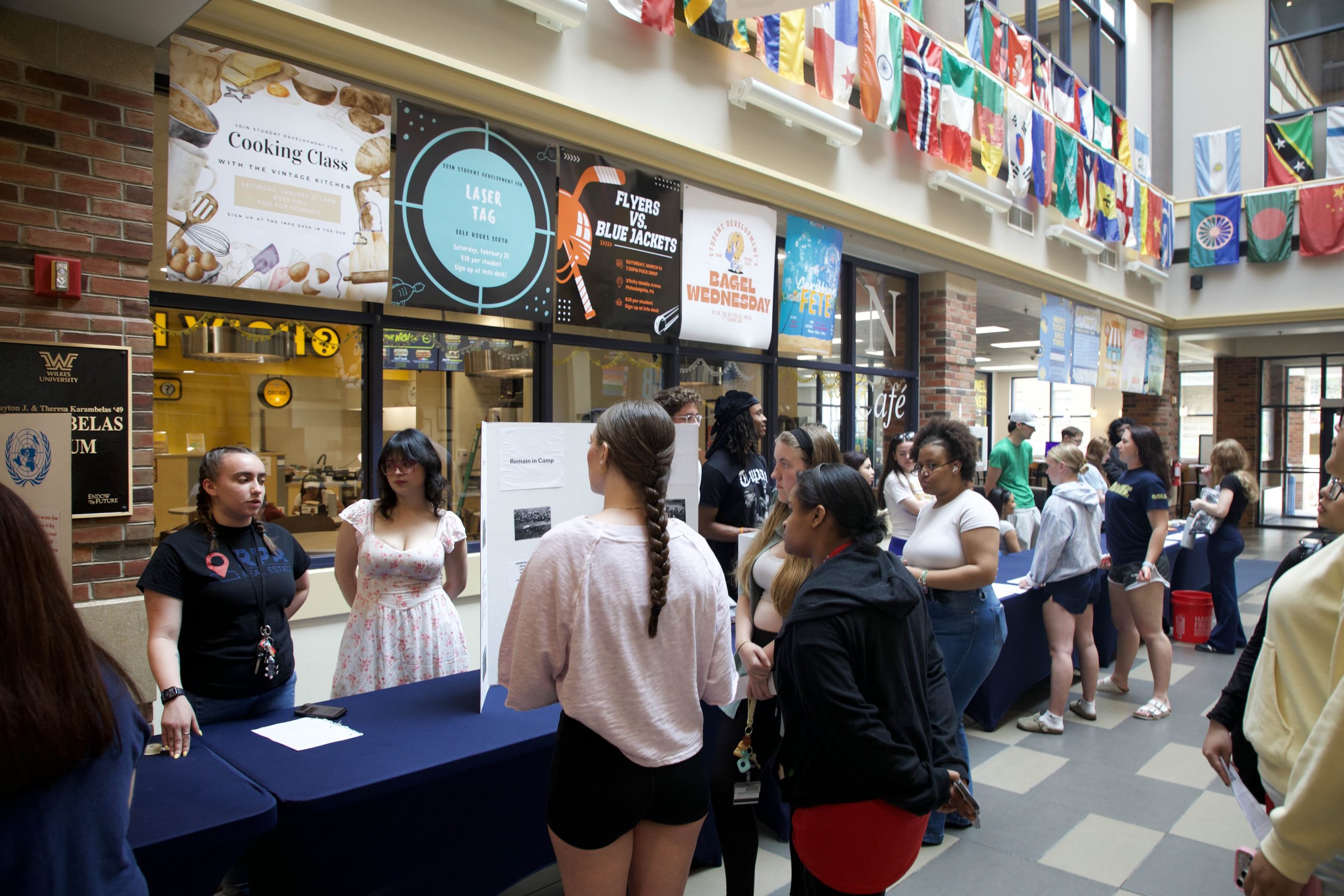
A political science class at Wilkes University went beyond the typical lectures and papers at the end of the spring semester. Students in PS 141 International Relations, taught by Andreea Maierean, associate professor of political science, hosted “Walk a Mile in My Shoes,” an interactive refugee awareness experience.
At the beginning of the event, modeled on a simulation designed by the non-governmental organization Jesuit Refugee Service, participants received a refugee identity with details about the individual’s life. One, Makuu, was a young woman born in an Internally Displaced Person Camp in the Democratic Republic of Congo, where violence caused 2.5 million people to flee their homes. Though Makuu was born without arms, she continues to seek an education with support from her parents, teachers and friends.
After receiving their identity, participants were directed to move through the first floor of the Henry Student Center, stopping at eight stations including shelter, food, water and education. Some were turned away and denied entry, immediately ending their journey. For those who were permitted to continue, the simulation representing key parts of a refugee’s life, took about 15 minutes.
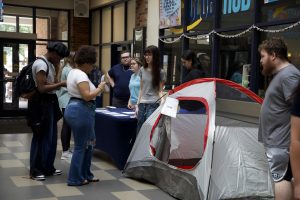
At the shelter station, senior political science and history major Emma Broda showed off a small tent that campers might use for a weekend getaway. But for a refugee family of four, the tent could be home for months or even years.
Delaney Borek, a first-year criminology major, talked about the basic diet available to refugees at the food station. Rations consist of rice, some vegetables, bread and beans, but no meat. “There’s no variety,” says Borek. “It’s the same thing, day after day.” And while the recommended calorie intake for the average adult is 2200 to 2500 calories, refugees likely take in 1000 calories less than that.
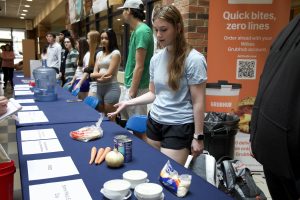
The eye-opening details continued at each station. The water allotment for a day equaled the amount used in a two-minute shower, and refugees need to carry the water, weighing 41 pounds, with them.
While aid organizations try to help, healthcare resources are minimal, and people in camps are subject to skin diseases and parasites as a result of overcrowding. Access to education is limited, and may cost money that most families don’t have. For the fewer than 50% lucky enough to receive some type of schooling, challenges include scarce supplies and language barriers.
Though participants moved through the stations in a matter of minutes, in the real world, refugees deal with these struggles for years. “It is important to note that our experience does not attempt to replicate refugee life,” says Maierean. “It simply highlights the structure of that experience: the lack of control, the waiting and the effects of scarcity.”
At the final station — destination — the simulation ends, but for refugees, the uncertainty continues. “It’s the start of them trying to figure out what to do for the rest of their lives,” says Miranda Woodburn, a junior political science and criminology major. Some people choose to return home, but according to estimates, only 1% to 3% make it back. Others attempt to settle elsewhere. Many remain in camps, some for as long as 17 years.
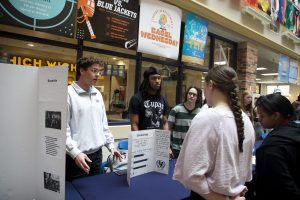
“The stats were very eye-opening,” says Hernandez.
However, Maierean and her students know that the statistics only tell part of the story. When teaching about migration, conflict and human rights in class, Maierean shares theories and data, but those tools may create distance from the human impact. By combining research and visuals including the small tent, limited food, water bucket and basic first aid supplies, she hopes that “Walk a Mile in My Shoes” helped to close the gap between concepts and the real world.
Maierean also hopes that active participation in the simulation enhanced student engagement, increased retention of information, created thoughtful discussions and raised awareness of issues refugees face. “Learning is more powerful when it has engagement,” says Maierean. “If I can connect students to displacement, they can see it differently.”
With polarizing viewpoints prevalent in politics and media, Maierean found the end of the semester an ideal time to present different perspectives on the complicated issues surrounding migration.
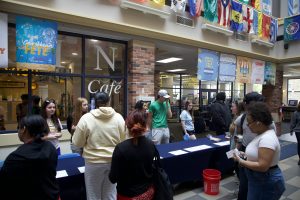
“Timing matters. ‘Walk a Mile in My Shoes’ gives us the opportunity to move beyond headlines and toward a better understanding of displacement,” says Maierean. “I’m trying to build empathy. If I could change one mind, I would be satisfied.”