For assistant biology professor Yuzo Yanagitsuru, it all boils down to something quite simple: “I like fish.”
It may sound straightforward, but anyone who knows him would understand that Yanagitsuru’s journey to Wilkes, and the research he oversees here, has been the culmination of a lifelong passion. From the early years raising fish at his childhood home in northern California, to his undergrad and graduate schooling, and finally, to the lab here at Wilkes, Yanagitsuru’s life has been driven by a love for fish. With the help of Wilkes’ Biology and Earth Systems Science (BESS) department, as well as curious and motivated students, Yanagitsuru currently oversees three research projects all born out of this fondness for fish.
“I was originally interested in understanding how fish are able to survive under different, often extreme environments,” he says. “But during my PhD it dawned on me how badly many fish populations are doing, so I became more interested in how physiological knowledge can be used to help protect them. It was also during my PhD that I became interested in the science of fish farming, known as aquaculture, which is one of the world’s fastest growing industries, because of the potential that it has to directly benefit both wildlife and human society.”
For the first research project, student Joe Sokolowski works to develop and test a theoretical method for the eradication of invasive aquatic species using the western mosquitofish as the invasive fish model. “Invasive aquatic species like fish are notoriously challenging to remove once established in a new environment,” Yanagitsuru explains. “So we are interested in new methods that could be used to remove them, especially ones that don’t involve poisoning the entire lake.”
Students Aiden Morgan, Zoe Morley, Gabby Ciborosky, Emily Hedglin and Rebecca Lubinski lead another research project focusing on a peculiar phenomenon Together, they examine why high temperatures, along with high nitrate conditions (which, by itself, generally poses a threat to aquatic biodiversity), appear to improve fish performance in some species. Uncovering the reason behind this phenomenon may prove useful to the aquaculture industry, where there is typically a high population density, and where higher temperatures are expected in the future.
On a third project, Haley Zapolski and Justin Sarker use zebrafish to measure physiological performance of larval, or baby, fish across different temperatures. The method they use has become common when working with juvenile and adult fish, but is relatively new and has never been validated for larval fish, a crucial life stage to study because it is one of the first bottlenecks toward population growth.
Zapolski, a junior biology major from Montrose, Pennsylvania, is considering going for a master’s degree, and then possibly a PhD. She credits Wilkes and Yanagitsuru for giving her the guidance and motivation to tackle whatever comes next. “The opportunity to do interesting research under Dr. Yanagitsuru at Wilkes definitely has, and will, help me get to wherever I end up going. I’ve learned so many hands-on skills through the ongoing research that I never would have had had I not joined in the very beginning,” she says.
Yanagitsuru credits the BESS department at Wilkes for the success of his research projects and for giving him both the space and freedom to pursue them. “The BESS department has been wonderful in providing me space and startup funds to set up the fish physiology lab,” says Yanagitsuru. In addition to the department, Yanagitsuru also points to the students as critical to research work in the lab. “The students have definitely been the most important support. I initially planned on having one or two projects but the quality, and luckily quantity, too, of the Wilkes students who were interested in working with fish has allowed me to shoot for three instead.”
Moving forward, Yanagitsuru hopes to build on some of this research and incorporate CRISPR-Cas9 gene editing into the lab, as well as exploring germ cell transplantation in fish, which has the potential to help improve captive spawning of endangered species.
Biology Professor and Students Dive Deep Into Fish Research
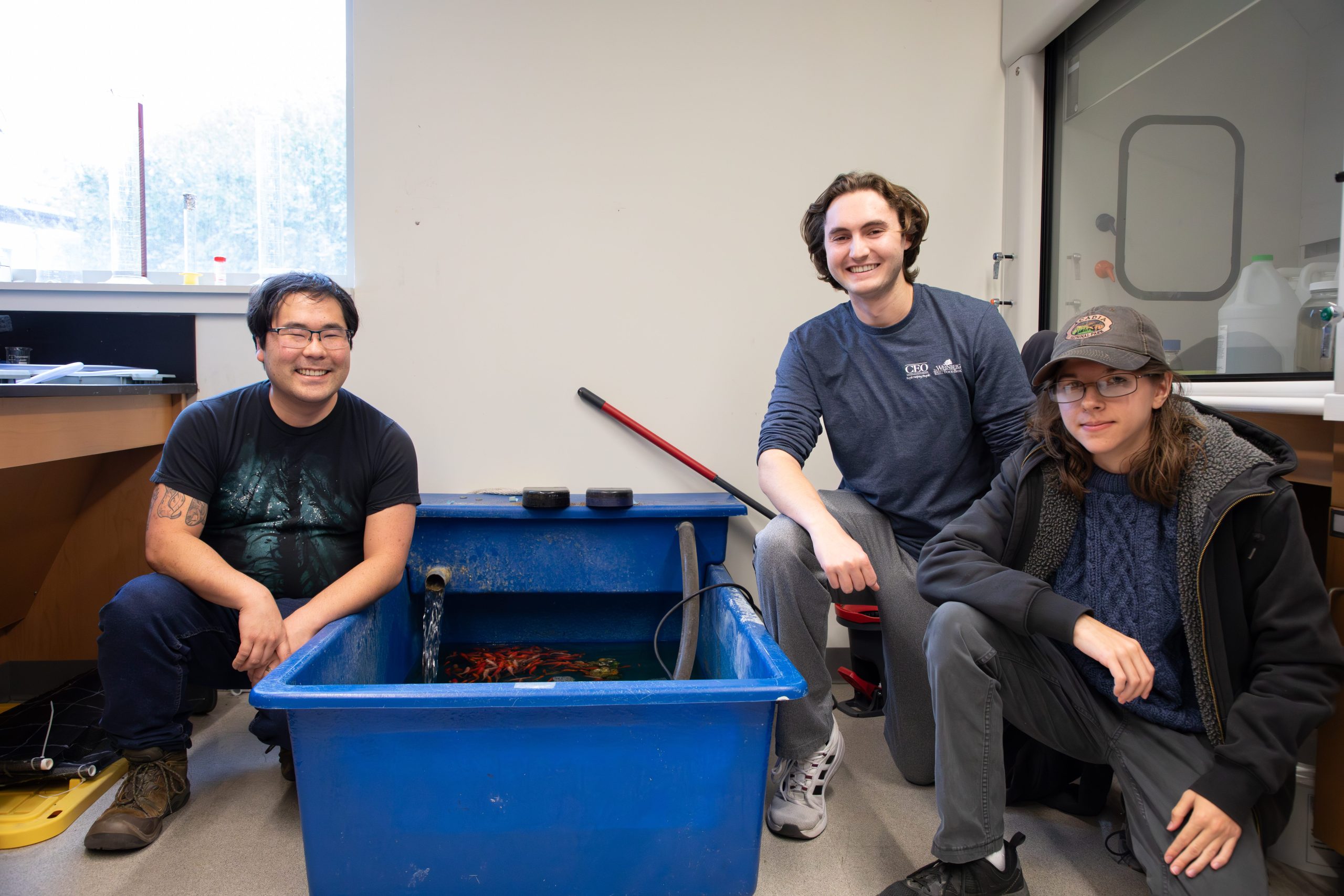
From left to right, Dr. Yanagitsuru with students Aiden Morgan and Joe Sokolowski
342